

The Ingredient Files
Turmeric, the root oil and the root extract.
Almost everything written about turmeric in skincare collapses two very different ingredients into one word. The oil pressed from the root and the extract drawn from it behave nothing alike. Getting that distinction right is most of the subject.
2
Forms of turmeric we use, root oil and root extract, doing two different jobs
3
PureNeem formulas that carry turmeric in one form or the other
4000
Years turmeric appears in the South Asian culinary and Ayurvedic record
One rhizome, two ingredients.
Curcuma longa is a rhizome in the ginger family, grown across South Asia and used daily in cooking long before anyone put it in a serum. Two quite different things come out of it, and cosmetic labels rarely make that clear.
Turmeric root oil is a pressed aromatic lipid. It is golden, it smells unmistakably of the spice, and it belongs in an oil phase. Turmeric root extract is a water or glycol soluble fraction, standardised, pale and largely odourless, and it belongs in a serum or a cleanser.
Curcumin is the compound most people name, and its chemistry is well documented, including the awkward fact that it is poorly soluble and not especially stable on its own (Priyadarsini, 2014). Everything else in the rhizome, including demethoxycurcumin and the volatile fraction, contributes to how each form behaves.

A large literature, mostly not about faces.
Turmeric carries one of the largest bodies of published research attached to any botanical, and the overwhelming majority of it sits in pharmacology rather than cosmetics (Chattopadhyay et al., 2004). A systematic review of the clinical evidence specifically on skin found the studies encouraging in places and thin in others, which is a fair summary (Vaughn et al., 2016).
Separate laboratory work has examined how curcumin interacts with melanogenesis in cultured human melanocytes (Tu et al., 2012). That is a cell culture finding, and we do not build a tone claim on top of it. In our formulas the tone work is done by the vitamin C derivative, alpha arbutin, niacinamide and licorice root, and turmeric is not asked to do that job.
What it is asked to do is narrower and more honest. Turmeric contributes antioxidant character and a warm, lit look to the skin. That is a sensory and visual contribution, and it is enough.

The colour problem, solved two ways.
The obvious objection to turmeric is that it is a dye. Anyone who has cooked with it knows what it does to a chopping board, and the fear of a yellow face is the main thing that keeps people away from it.
Both of our forms solve that, differently. The root oil goes into a blend where jojoba oil, rosehip and sea buckthorn carry most of the volume, so the colour reads as warmth in the bottle and disappears on the skin. The root extract is standardised and used at a fraction of a percent, where it carries no visible colour at all.
It also sits comfortably next to the botanicals it grew up with. Neem and licorice root are the traditional companions, and in a modern formula they still balance each other, one assertive, one calming, one aromatic.

Glow is the point. Gold is only the colour it arrives in.
Three turmerics, three outcomes.
If you take one thing from this page, take this table. It explains why a homemade turmeric mask and a turmeric serum produce such different results.
| Form | Where it goes | What to expect |
|---|---|---|
| Turmeric root oil | Oil phase, facial oils and balms | Aromatic, warm, contributes to a lit finish |
| Turmeric root extract | Water phase, serums and cleansers | Standardised, odourless, no visible colour |
| Ground culinary turmeric | Your kitchen, not your face | Unstandardised, stains, unpredictable on skin |
The kitchen version is the one that gives turmeric its reputation for staining, and it is also the one with no consistency from jar to jar. A cosmetic extract exists precisely so that a formulator knows what is in it. If you want the equivalent argument about vitamin C formats, we wrote it on ethyl ascorbic acid versus L ascorbic acid.
Three products, two forms.
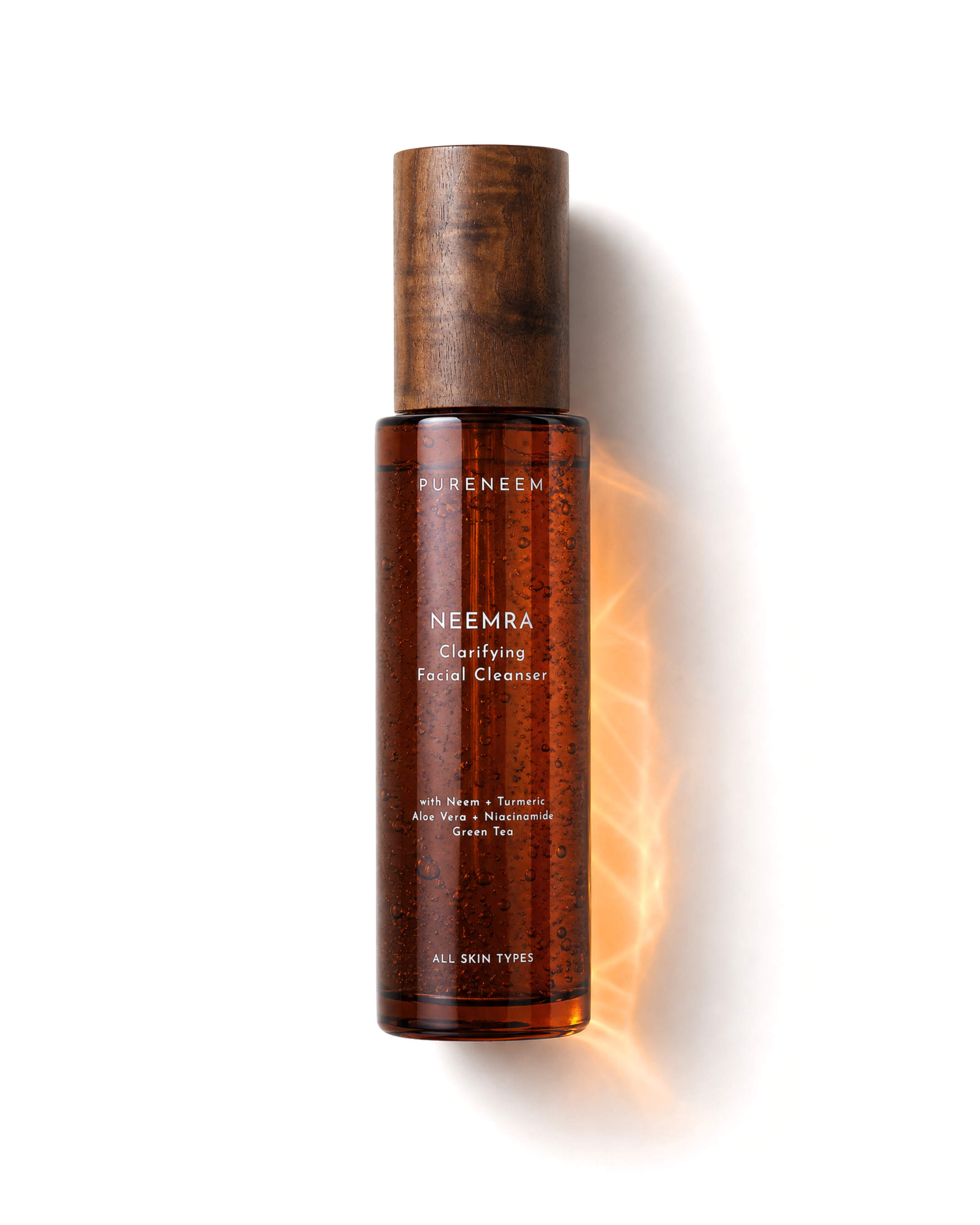
Turmeric root extract is also in Neemra Clarifying Facial Cleanser, where it sits with neem and aloe in the wash. These two are where each form of turmeric leads.
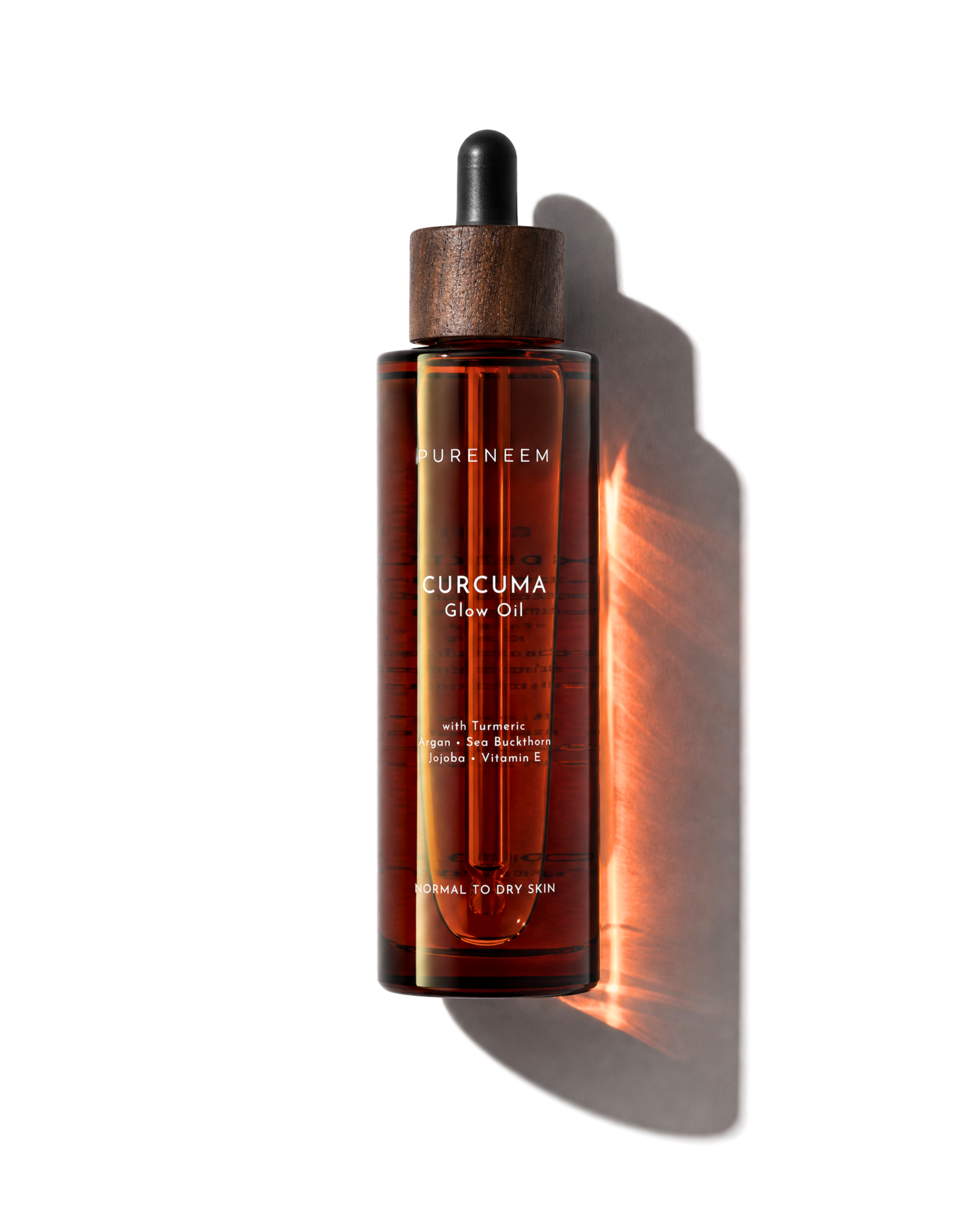
The only place we use the pressed root oil, and it is the centre of the blend rather than a note in it. The finish is the whole design brief here, so it absorbs rather than sits, and skin reads lit instead of oily.
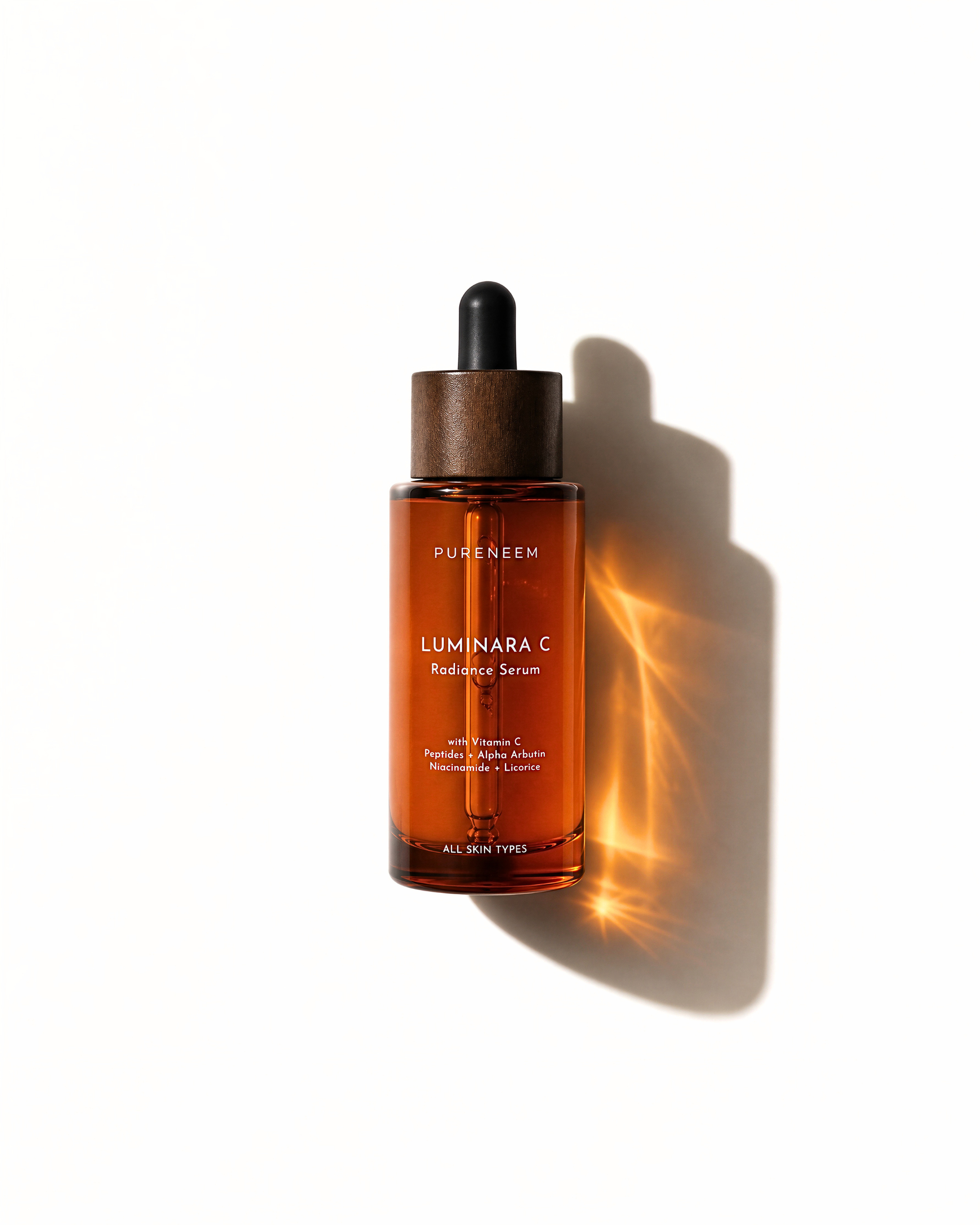
Here the extract is a supporting botanical, adding antioxidant character underneath the actives that carry the tone work. No colour, no scent, no interference with a serum that has to layer cleanly under everything else.
A practical note on radiance
Turmeric is a contributor to the look of radiance, not the engine of it. If an even, luminous look is what you are after, the ingredient doing most of that work is a well chosen vitamin C, with the botanicals supporting it.
Our vitamin C guide sets out which derivative suits which skin, how to layer it, and why the percentage printed on the front of the bottle tells you very little on its own.
Common questions
Turmeric, answered plainly.
Does turmeric skincare stain your skin yellow?
A standardised cosmetic extract does not. Ground culinary turmeric absolutely can, which is where the reputation comes from. Our oil blend carries the root oil at a level where the colour stays in the bottle.
What does turmeric do for your face?
In a cosmetic formula it contributes antioxidant character and supports the look of a warm, lit complexion. It is a supporting botanical rather than the active carrying a formula, and we are careful not to claim more than that.
Is turmeric root oil the same as turmeric extract?
No, and this is the most useful distinction on the whole subject. The oil is an aromatic lipid for oil based products. The extract is a standardised water soluble fraction for serums and cleansers. They are not interchangeable.
Can you use turmeric with vitamin C?
Yes, and they are frequently formulated together. Turmeric extract adds antioxidant support without competing for the same role, which is why it sits underneath the vitamin C rather than beside it.
Is a homemade turmeric mask worth doing?
It is the version most likely to stain and the least predictable, because kitchen turmeric is not standardised and the amount of active compound varies from jar to jar. A formulated product exists so that the dose is known.
References
- Chattopadhyay, I., Biswas, K., Bandyopadhyay, U., and Banerjee, R. K. (2004). Turmeric and curcumin: Biological actions and medicinal applications. Current Science, 87(1), 44 to 53.
- Priyadarsini, K. I. (2014). The chemistry of curcumin: From extraction to therapeutic agent. Molecules, 19(12), 20091 to 20112.
- Tu, C. X., Lin, M., Lu, S. S., Qi, X. Y., Zhang, R. X., and Zhang, Y. Y. (2012). Curcumin inhibits melanogenesis in human melanocytes. Phytotherapy Research, 26(2), 174 to 179.
- Vaughn, A. R., Branum, A., and Sivamani, R. K. (2016). Effects of turmeric (Curcuma longa) on skin health: A systematic review of the clinical evidence. Phytotherapy Research, 30(8), 1243 to 1264.
Golden Radiance: Turmeric Rituals