


The Ingredient Files
Vitamin E, and the company it keeps.
Tocopherol is near the end of almost every ingredient list you own, and it is doing two jobs there rather than one. Here is what it protects, why it is almost never used alone, and how to read the four versions of it you will see on a label.
8
Naturally occurring forms of vitamin E, four tocopherols and four tocotrienols
0.1 to 1%
The range tocopherol is normally used at in a finished formula
5
PureNeem formulas that carry it, from face wash to body balm
Eight molecules, one name.
Vitamin E is not a single compound. It is a family of eight fat soluble molecules, four tocopherols and four tocotrienols, of which alpha tocopherol is the most biologically active and the one skincare almost always means.
Because it is fat soluble, it sits in the lipid parts of the formula and the lipid parts of the skin, which is precisely where oxidation does its damage. Skin holds its own reserves of it in sebum and in the barrier lipids, and those reserves fall with sun exposure and with age (Thiele et al., 2005).
That location is the whole argument. A water soluble antioxidant cannot reach the oils. Vitamin E lives in them, which makes it the default protection for the lipid side of the equation.
It is better in a pair.
The most useful finding about vitamin E is that it does not like working alone. Published work has examined topical vitamins C and E applied together and compared that combination against either one on its own under ultraviolet exposure (Lin et al., 2003).
The reason is chemistry. When vitamin E neutralises a radical it is spent, and vitamin C restores it so it can carry on. One protects the oil phase, the other the water phase, and each keeps the other in play. Separate research has looked at how delivery systems change the amount of vitamin E that reaches the skin lipids and what happens to barrier measurements afterwards (Ekanayake-Mudiyanselage et al., 2005).
Stated plainly, vitamin E helps defend the lipids in your skin and in your products against oxidation. It is a supporting antioxidant with a long record, not a corrective active.

It protects the formula too.
Any product with plant oils in it has an oxidation problem. Oils go rancid, the scent turns, and the actives suspended in them degrade. Tocopherol is the standard defence, which is why it appears at the end of so many ingredient lists at a fraction of a percent.
That gives it a dual role that few ingredients have. It keeps the oils stable in the jar, and once applied it joins the antioxidant load on the skin. Beside green tea it covers the phase green tea cannot reach, and in a rich formula it protects the fatty acids in shea butter while the ceramides handle the barrier.

The ingredient that keeps the rest of the bottle honest.
Four names, four behaviours.
Vitamin E appears under several INCI names and they are not equivalent. This is what each one tells you.
| On the label | What it is | What it means in the formula |
|---|---|---|
| Tocopherol | The free alpha form, ready to work | Active immediately, less stable in the bottle |
| Tocopheryl acetate | An ester of tocopherol | Very stable, but skin has to convert it first |
| Tocopheryl linoleate | An ester with linoleic acid | Oil soluble and conditioning, slower to release |
| Mixed tocopherols | A natural blend of the tocopherol forms | Usually there to protect the oils in the product |
Neither the free form nor the ester is simply better. The free form acts sooner, the ester survives the shelf. Which one a formulator chooses tells you what they were optimising for.
Five formulas, two worth explaining.
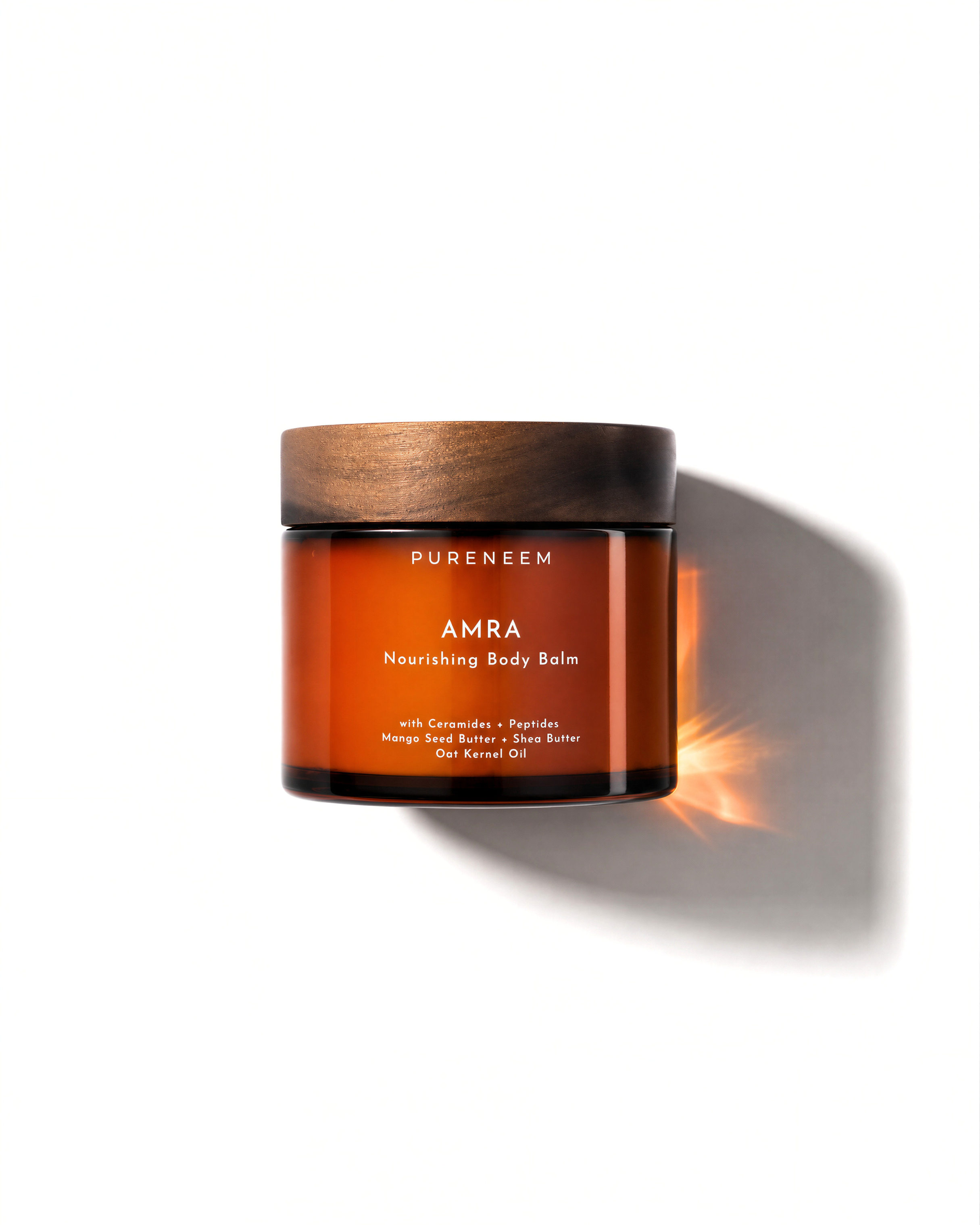
Tocopherol is in the Amra balm, the Mucina cream, the Rejuvence night cream, the Neemra cleanser and the Coco & Char exfoliant. These two show the two different reasons it is there.
This formula is mostly butters and oils, which is exactly the material vitamin E exists to protect. It keeps the lipid base stable over the life of the jar and adds to the antioxidant load on skin that gets a fraction of the care your face does.
Retinol is an unstable molecule in an oxygen rich world. Tocopherol sits alongside it and the vitamin C derivative here, protecting the formula and covering the lipid phase while the actives work overnight.
A practical note on pairing C with E
Vitamin E is most useful when there is a vitamin C in the routine for it to work with. That pairing is the reason a good morning serum outperforms a single ingredient product, and it costs nothing to set up.
Our guide to the best vitamin C serum in Australia covers which derivatives stay stable here, and how to layer the two without either going to waste.
Common questions
Vitamin E, answered plainly.
What does vitamin E do for your skin?
It is a fat soluble antioxidant, so it defends the lipid parts of the skin against oxidation from daylight and pollution. It also conditions the surface and helps skin hold moisture. In a product it doubles as the thing keeping the oils from turning.
Is tocopherol the same as vitamin E?
Tocopherol is the most active member of the vitamin E family and the form skincare usually means. Tocopheryl acetate is a more stable ester of it that skin converts before it becomes active. Both count as vitamin E on a label.
Can vitamin E clog pores?
Pure vitamin E oil is heavy and can feel occlusive on skin that is already oily. At the fraction of a percent used in a well built formula that is not the issue. The carrier oils around it matter far more than the tocopherol itself.
Should you use vitamin E with vitamin C?
Yes. They work on opposite sides of the water and oil divide and they keep each other in play, which is why the combination has been studied so often. Most well built antioxidant routines already contain both.
Can you put pure vitamin E oil on your face?
You can, though there is rarely a good reason to. Neat tocopherol is thick, slow to absorb and a common enough contact allergen that dermatologists see it regularly. A formulated product delivers it at a sensible level in a base that actually wears well.
References
- Ekanayake-Mudiyanselage, S., Tavakkol, A., Polefka, T. G., and Thiele, J. J. (2005). Vitamin E delivery to human skin by a novel delivery system and its impact on skin lipid parameters. Journal of the American Academy of Dermatology, 52(3), 483 to 484.
- Farris, P. K. (2005). Topical vitamin C: a useful agent for photoaging and other dermatologic conditions. Dermatologic Surgery, 31(7), 814 to 818.
- Lin, J. Y., Selim, M. A., Shea, C. R., Grichnik, J. M., Omar, M. M., Monteiro-Riviere, N. A., and Pinnell, S. R. (2003). UV photoprotection by combination topical antioxidants vitamin C and vitamin E. Journal of the American Academy of Dermatology, 48(6), 866 to 874.
- Thiele, J. J., Hsieh, S. N., and Ekanayake-Mudiyanselage, S. (2005). Vitamin E: critical review of its current use in cosmetic and clinical dermatology. Dermatologic Surgery, 31(7), 805 to 813.
Vitamin E Essentials